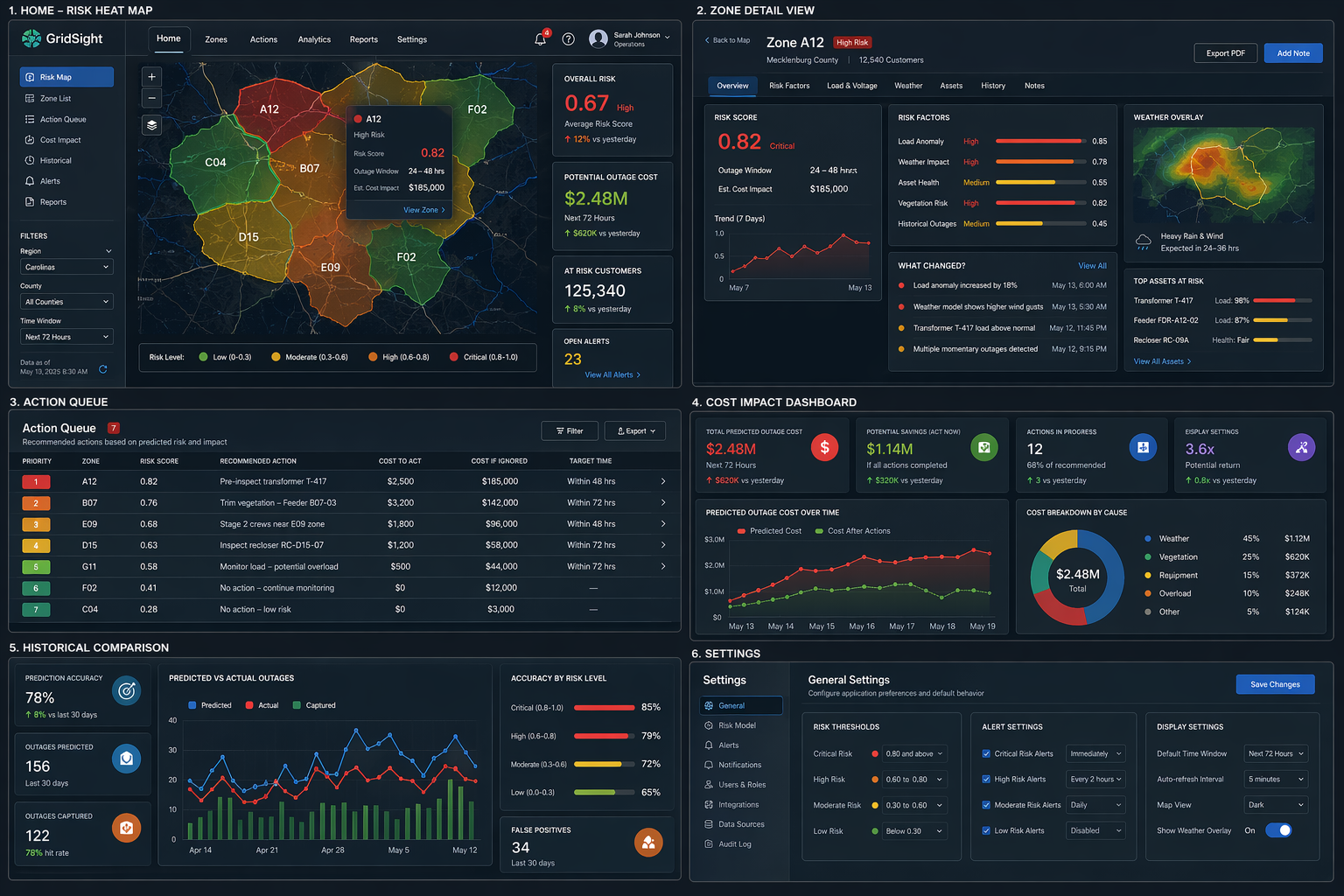
Portfolio entry · Web application
GridSight
Predictive risk for the power grid — heat maps, soup-to-nuts notifications, and action queues that protect stability before the outage hits.
Current infrastructure — with or without GridSight
Toggle between baseline ops and GridSight-integrated prediction, alerts, and outage avoidance.
Overall risk
0.67
72-hour predictive score
Outage exposure
$2.48M
Exposure before mitigation
Open alerts
23
Proactive open alerts
Projected savings
$1.14M
If action queue clears
Notification system
Soup to nutsDetect
Score
Fan-out
Escalate
Queue
Mode syncs with the browsable templates via localStorage.
Open interactive templates →Predict. Notify. Act.
GridSight turns reactive outage response into a predictive ops loop — risk heat maps, multi-channel alerts, and costed action queues on Flask, Celery, and Redis.
Infrastructure heat map
Zone-level risk for the next 72 hours with outage windows and estimated cost impact on every sector.
Soup-to-nuts alerts
Detect → score → Email / SMS / Teams / PagerDuty fan-out → escalate → action queue, with quiet hours and digests.
Outage avoidance ROI
Cost to act vs cost if ignored, projected savings, and historical prediction accuracy for the NOC.
Case study
Predictive grid risk and notification fan-out for utility operations.
Problem solved
Operators saw status after the fact — reactive tickets, no predictive heat map, and no coordinated alert pipeline before customers lost power.
Approach
- 72-hour zone risk scores with costed mitigation actions
- End-to-end notification pipeline across Email, SMS, Teams, and PagerDuty
- Cost-impact and historical accuracy views for outage avoidance ROI
Architecture
Tech stack
- Flask / SQLAlchemy
- Ops UI + REST APIs
- Celery / Redis
- Prediction pipeline
- PostgreSQL
- Zones, risk, actions
- scikit-learn
- Risk scoring models
Timeline & team
Business impact
- Portfolio/portfolio/gridsight/
- DemoSimulated analysis + interactive templates
- FocusStability & outage avoidance ROI
Screenshots